MathQuizily ranked #372 in TIME and Statista's World's Top EdTech Companies 2026.Read the announcement
← Back to Blog

Why Free Math Tools Fail at Assessment (And What Teachers Use Instead) – 2026

By Edin Adilagic
#freemathtools#mathassessment#AIexams
Why Free Math Tools Fail at Assessment (And What Teachers Use Instead) – 2026
Free math tools work for practice — but fail at real assessment. Learn why teachers in 2026 use structured, AI-generated math exams instead.

Need a classroom-ready assessment? Use our AI math test generator for teachers to create a printable PDF with answer keys in minutes.

For the full guide, see AI math exams and assessment.

Free math tools work for practice — but fail at real assessment. Learn why teachers in 2026 use structured, AI-generated math exams instead.

The Hidden Gap in Free Math Tools

Free math tools are everywhere in 2026.

Students use them daily. Teachers recommend them for practice. Parents rely on them for homework support.

But when assessment matters — most free math tools quietly fail.

Not because they are bad tools.

But because they were never designed for assessment.


Practice ≠ Assessment (And Why That Difference Matters)

Practice tools focus on:

  • Repetition
  • Instant feedback
  • Trial-and-error learning
  • Assessment requires something completely different:

  • Controlled difficulty
  • Alignment with learning objectives
  • Comparable results
  • Fair grading conditions
  • A student can score highly in practice and still fail an exam — not because they lack knowledge, but because practice environments don't simulate assessment.

    Learn more: From Practice to Proof: Why Math Learning Needs Better Exams


    What Free Math Tools Usually Lack

    Free tools typically fail in four critical areas:

    1. No Structured Difficulty

    Questions are often random or adaptive in ways that:

  • Vary between students
  • Change mid-session
  • Prevent fair comparison
  • Assessment requires fixed structure, not continuous adaptation.

    2. No Curriculum Control

    Many free tools:

  • Mix standards
  • Skip learning goals
  • Prioritize engagement over alignment
  • For teachers, this creates risk.

    A test must reflect what was actually taught.

    Learn more: AI Math Test Generator (2026): The Complete Guide

    3. No Printable, Exam-Ready Format

    Assessment still happens offline:

  • Classrooms
  • Exams under supervision
  • Limited devices
  • Most free tools are:

  • Online-only
  • Screen-dependent
  • Unsuitable for controlled exams
  • Printable PDF exams remain essential.

    Learn more: Why Printable Assessments Still Matter in an AI-First Classroom

    4. No Reliable Grading Support

    Free tools often:

  • Show answers, not grading logic
  • Skip partial credit
  • Ignore reasoning steps
  • Teachers need:

  • Clear answer keys
  • Consistent grading structure
  • Transparent assessment logic

  • Why Teachers Outgrow Free Tools

    Free tools are excellent for:

  • Warm-ups
  • Homework
  • Revision
  • Confidence building
  • But teachers eventually hit a wall when they need to:

  • Measure progress
  • Assign grades
  • Prepare students for exams
  • Document results
  • That's when many educators move to AI-generated exam tools.


    What Teachers Use Instead in 2026

    Teachers are not abandoning technology.

    They are upgrading it.

    Modern assessment-focused tools provide:

  • Structured test generation
  • Topic-level control
  • Fixed difficulty levels
  • Printable PDF exams
  • Answer keys and grading support
  • This shift is about precision, not automation.

    Learn more: How Teachers Create Complete Math Exams in Minutes Using AI


    AI-Generated Exams vs Free Worksheets

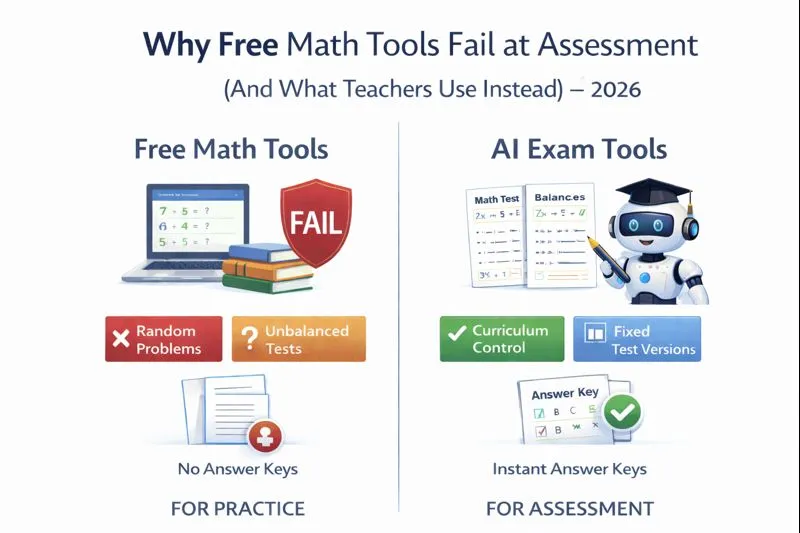
    FeatureFree ToolsAI Exam Tools
    Random questions✅❌
    Controlled difficulty❌✅
    Curriculum alignment❌✅
    Printable exams❌✅
    Grading support❌✅

    Free tools help students practice.

    AI exam tools help teachers assess.


    Why Assessment Quality Impacts Student Outcomes

    Poor assessment causes:

  • False confidence
  • Unclear feedback
  • Unfair grading
  • Student frustration
  • High-quality assessment:

  • Reveals real understanding
  • Builds exam confidence
  • Improves learning focus
  • Supports fairness
  • Research increasingly shows that structured exams improve learning outcomes, not just measure them.


    The Rise of Pay-Per-Test Assessment Tools

    Many teachers do not need:

  • Daily subscriptions
  • Complex dashboards
  • Long-term contracts
  • They need:

  • A test
  • Now
  • Aligned to their lesson
  • Pay-per-test models solve this by:

  • Removing commitment
  • Lowering cost
  • Matching real teacher workflows

  • FAQ – Free Math Tools vs Assessment

    Are free math tools bad?

    No. They are excellent for practice — just not for grading or exams.

    Can free tools be used for tests?

    Rarely. They lack structure, control, and exam conditions.

    Why not just adapt free worksheets?

    Manual adaptation costs teachers hours and still lacks consistency.

    Is AI assessment fair?

    When designed correctly, AI-generated exams are often more fair than manual tests.


    Short Summary

    Free math tools are powerful — but only for practice.

    When assessment matters, teachers need:

  • Structure
  • Alignment
  • Consistency
  • Printable exams
  • That's why, in 2026, more educators are switching from free tools to AI-generated math exams built for real assessment.


    Create Structured, Exam-Ready Math Tests

    If you're tired of adapting free worksheets into exams, it's time to upgrade your assessment workflow.
    Create a structured, exam-ready math test in minutes

    Ready to Create Your Custom Math Test?

    Try MathQuizily's Pay-Per-Test feature today. Only $1 USD / €1.25 EUR / 12.50 SEK per test.

    Create Your Test Now →
    📚 RELATED ARTICLES
    1

    How to Design a Fair Math Test With Easy, Medium and Hard Questions

    Learn how to design a fair math test using the 5-3-2 model of easy, medium, and hard questions. Create balanced assessments that measure foundational understanding, application, and reasoning.

    Read more
    2

    Printable Math Tests With Answer Keys: What Teachers Should Look For

    A printable math test should be ready for the classroom. Learn what teachers should look for in a test with an answer key, clear formatting, balanced difficulty and real classroom usability.

    Read more
    3

    How to Build an Algebra 1 Test That Actually Measures Understanding

    Learn how to build an Algebra 1 test that measures understanding with varied evidence, multiple representations, balanced difficulty and a worked answer key.

    Read more

    Explore related tools

    Classroom assessment context

    Build the assessment, not just the questions

    MathQuizily helps teachers move from a topic or standard to a printable math test with answer keys, balanced difficulty, and classroom-ready PDF output.

    A useful assessment should make the learning target clear, cover the intended skills, and give the teacher enough information to review the result before students see it. The workflow supports short quizzes, chapter checks, diagnostic tests, homework packets, make-up assessments, and equivalent retake versions.

    Choose a grade, topic, curriculum context, and difficulty level. The generated PDF includes a student version and a separate worked answer key, so teachers can print, review, and grade without reformatting questions or building solutions from scratch. No student account is required to create or print a test.