Need a classroom-ready assessment? Use our AI math test generator for teachers to create a printable PDF with answer keys in minutes.
For the full guide, see math assessment with AI.
Regional Math Test Generators
A fair math test is not necessarily an easy test.
It is an assessment that gives students a reasonable opportunity to demonstrate what they know while still distinguishing different levels of understanding.
Difficulty therefore needs to be deliberate.
The Problem With Random Difficulty
When teachers assemble tests from several different sources, difficulty can become accidental.
Three difficult problems may appear in a row.
The first page might be far harder than the second.
A supposedly simple question may contain arithmetic that makes it unexpectedly challenging.
Students experience the result as inconsistent, and the final score becomes harder to interpret.
Start With Foundational Questions
Every assessment should establish whether students understand the essential skills.
These questions do not need to be trivial.
They simply measure the core learning objective directly.
For example, during a unit on linear equations, foundational questions might ask students to solve equations using methods practiced repeatedly in class.
Students who understand the basic skill should have a reasonable opportunity to show it.
Add Application Questions
The next level asks students to use their knowledge rather than merely repeat a familiar procedure.
The mathematical concept remains recognizable, but students may need to select a method, combine steps or interpret information.
This is often where differences in understanding become clearer.
Finish With Deeper Reasoning
A small number of difficult questions can reveal whether students can extend their understanding.
These might require multiple concepts, unfamiliar representations, explanation or modeling.
The important word is small.
If every question is designed as a challenge problem, the assessment loses its ability to distinguish foundational mastery from advanced reasoning.
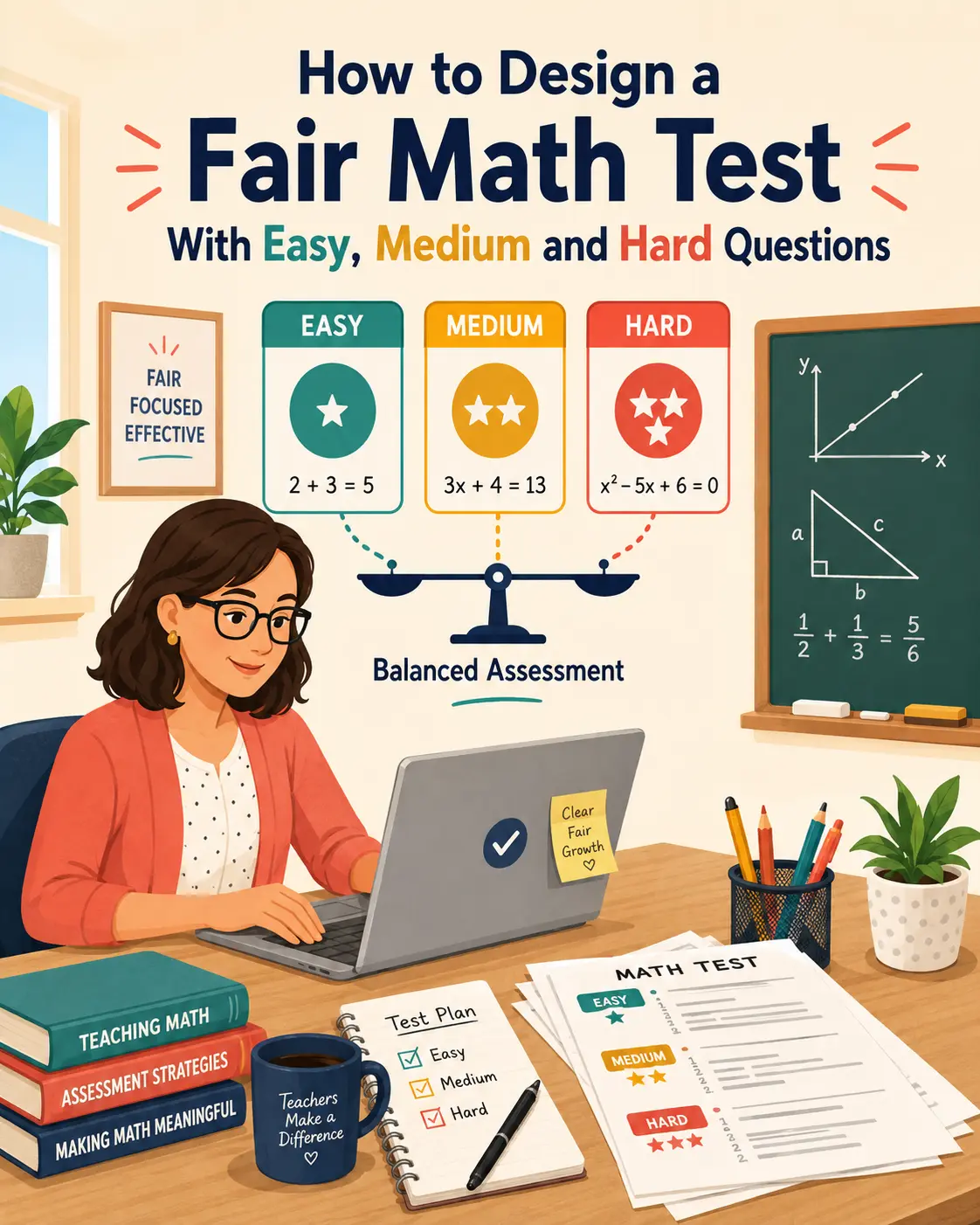
A 5–3–2 Assessment Structure
One possible model for a ten-question test is:
This is the structure currently used by MathQuizily's test generator.
The exact numbers are not a universal rule.
The value comes from thinking deliberately about distribution before writing the questions.
Fair Does Not Mean Everyone Gets the Same Score
A well-designed test should allow stronger understanding to produce stronger performance.
But students who understand the essential material should not fail simply because the assessment is dominated by unusually difficult problems.
Likewise, a student should not receive an exceptional score after demonstrating only routine procedural knowledge if the course expects deeper application.
Balanced difficulty creates room for both.
Review Difficulty After Writing the Test
Before using the assessment, label each question:
Then look at the whole test.
If almost everything lands in one category, consider adjusting it.
Also check whether question order makes sense.
A gradual progression often creates a better student experience than placing the hardest question first.
Assessment Design Is Information Design
Ultimately, a math test exists to give the teacher information.
Did the student master the basic skill?
Can the student apply it?
Can the student reason beyond a familiar example?
When assessment difficulty is deliberately structured, the final score becomes easier to interpret.
That makes the test more useful not only for grading, but for deciding what to teach next.