Need a classroom-ready assessment? Use our AI math test generator for teachers to create a printable PDF with answer keys in minutes.
For the full guide, see math assessment with AI.
Regional Math Test Generators
A strong Algebra 1 test should measure more than whether students can repeat a procedure they practiced the night before.
Students should demonstrate that they can manipulate expressions, solve equations, interpret representations and apply algebraic reasoning to unfamiliar situations.
That makes test design especially important.
Create a printable Algebra 1 test with an answer key →
Start With the Unit Objectives
Do not begin by searching for questions.
Begin with the concepts students were expected to learn.
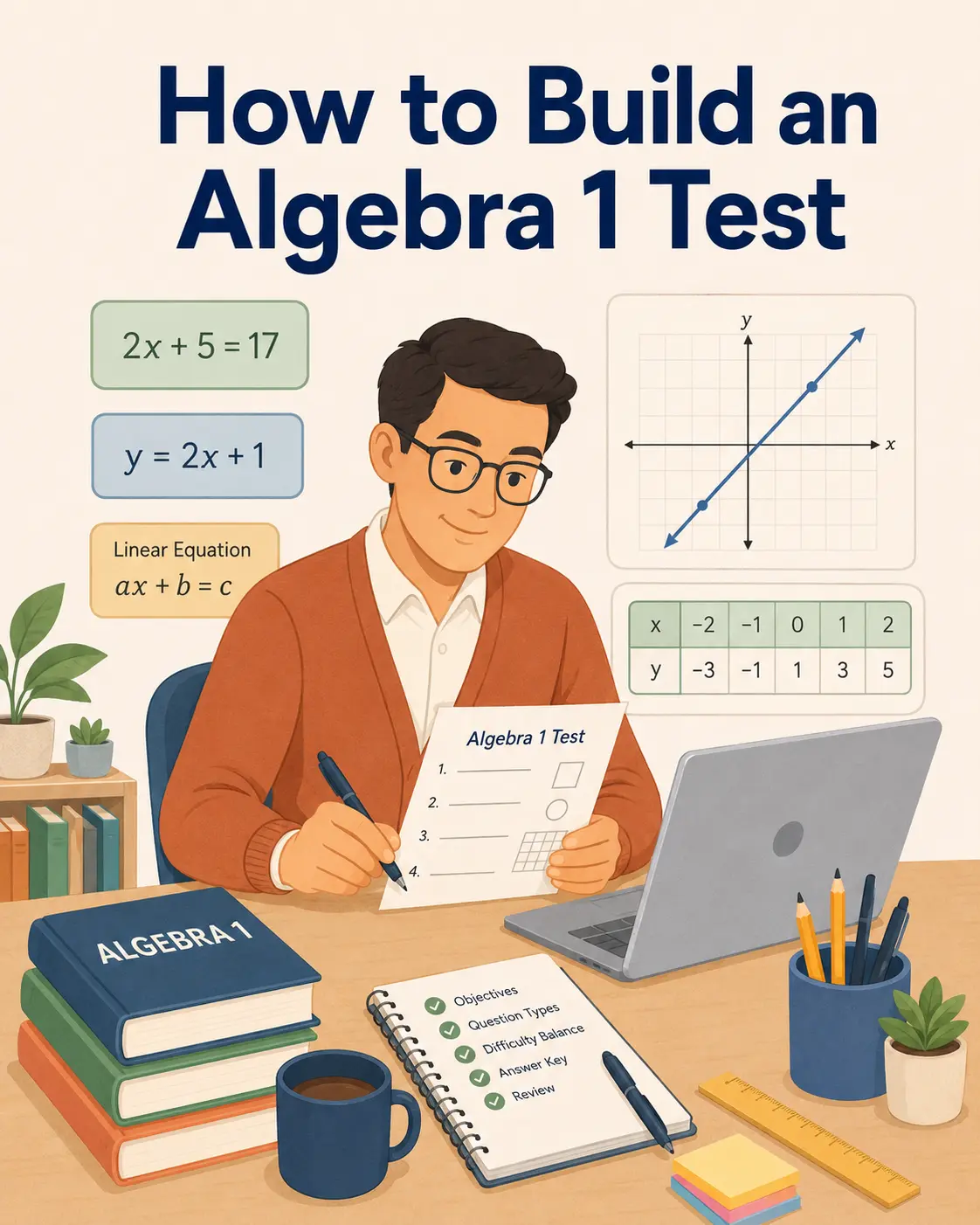
For a linear-equations unit, those might include solving one-step equations, solving multi-step equations, equations with variables on both sides, inequalities and translating situations into equations.
For a functions unit, the objectives might include identifying functions, evaluating function notation, interpreting rate of change and connecting equations, tables and graphs.
The assessment should reflect that blueprint.
MathQuizily's existing Algebra 1 generator covers classroom assessment workflows with printable output and answer keys.
Avoid Ten Versions of the Same Procedure
Suppose students solve ten linear equations.
That may tell you whether they can execute the algorithm.
But it does not necessarily tell you whether they understand what an equation represents or can use it in context.
Instead, vary the form of the evidence.
Ask students to solve an equation.
Ask them to identify an error.
Ask them to create an equation from a situation.
Ask them to interpret a solution.
Ask them to decide whether two equations are equivalent.
Now the test measures a broader understanding of the concept.
Build Difficulty Gradually
An Algebra 1 assessment can begin with accessible skills and increase in complexity.
Early questions establish whether students have the fundamentals.
Middle questions require combinations of skills.
Later questions can involve modeling, interpretation or multiple steps.
That gives students a reasonable entry point while still allowing high-performing students to demonstrate deeper understanding.
Use Multiple Representations
Algebra is not only symbolic manipulation.
Where appropriate, include equations, graphs, tables and verbal descriptions.
A student who can move between these representations demonstrates something different from a student who can only perform symbolic procedures.
This is particularly useful when assessing functions and linear relationships.
Watch the Arithmetic
An Algebra 1 test should primarily assess algebra.
If every problem contains awkward fractions and difficult mental arithmetic, the test may unintentionally measure arithmetic fluency more heavily than the algebraic objective.
Sometimes fractions are absolutely part of the skill.
But their use should be intentional.
Include a Worked Answer Key
An answer key containing only:
x = 7
may be sufficient for checking the final answer, but it provides limited help when grading student reasoning.
A worked solution makes it easier to identify common errors and determine where partial credit may be appropriate.
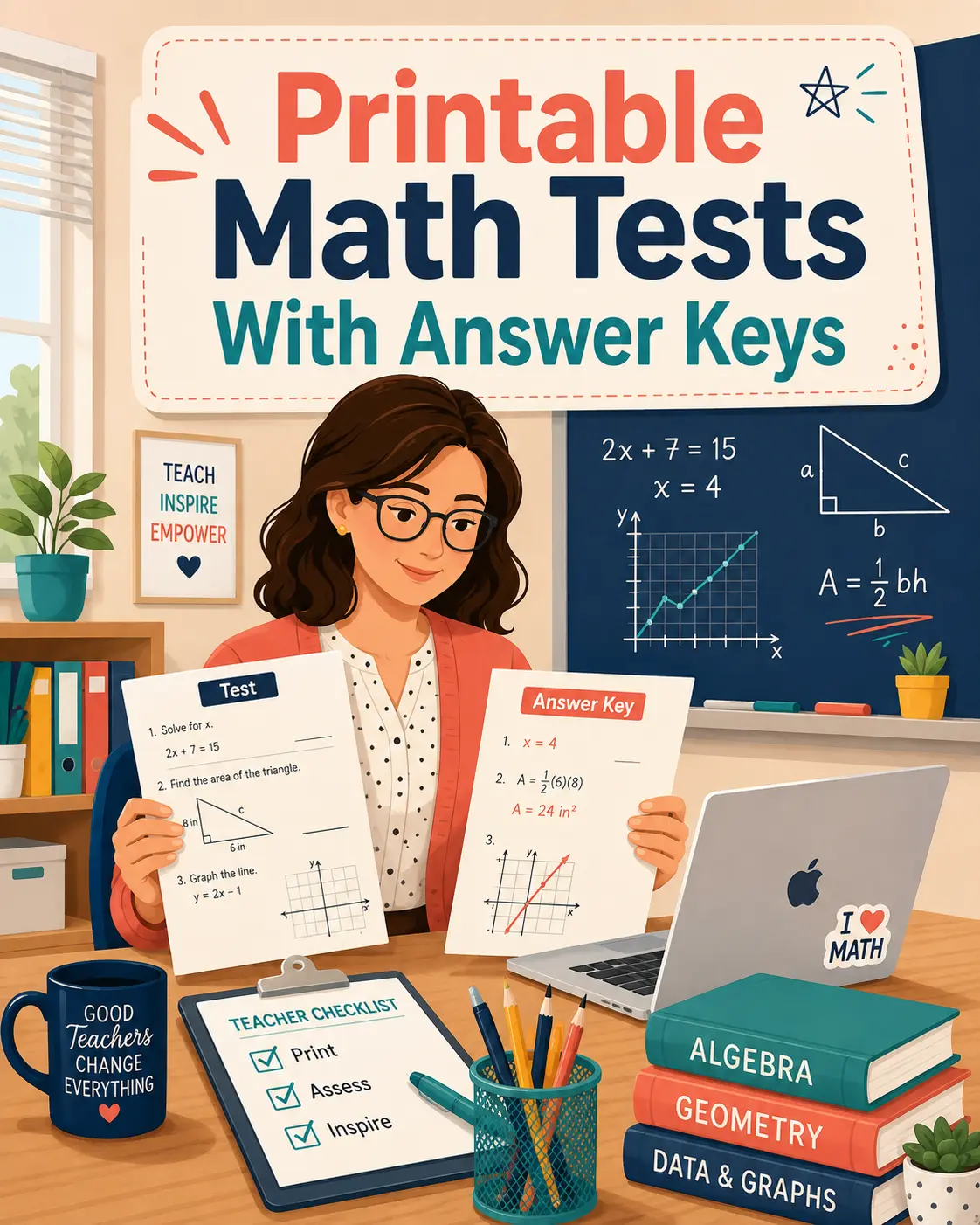
MathQuizily generates Algebra 1 assessments as printable PDFs with answer keys and uses balanced difficulty rather than an unstructured list of questions.
Final Check Before Printing
Read every problem as if you were a student.
Does it measure something taught?
Is the mathematical language clear?
Is the difficulty intentional?
Is there adequate working space?
Does the answer key match?
Does the collection of questions represent the unit?
If the answer is yes, you have an assessment—not just a worksheet with a score attached.