Need a classroom-ready assessment? Use our AI math test generator for teachers to create a printable PDF with answer keys in minutes.
For the full guide, see math assessment with AI.
Regional Math Test Generators
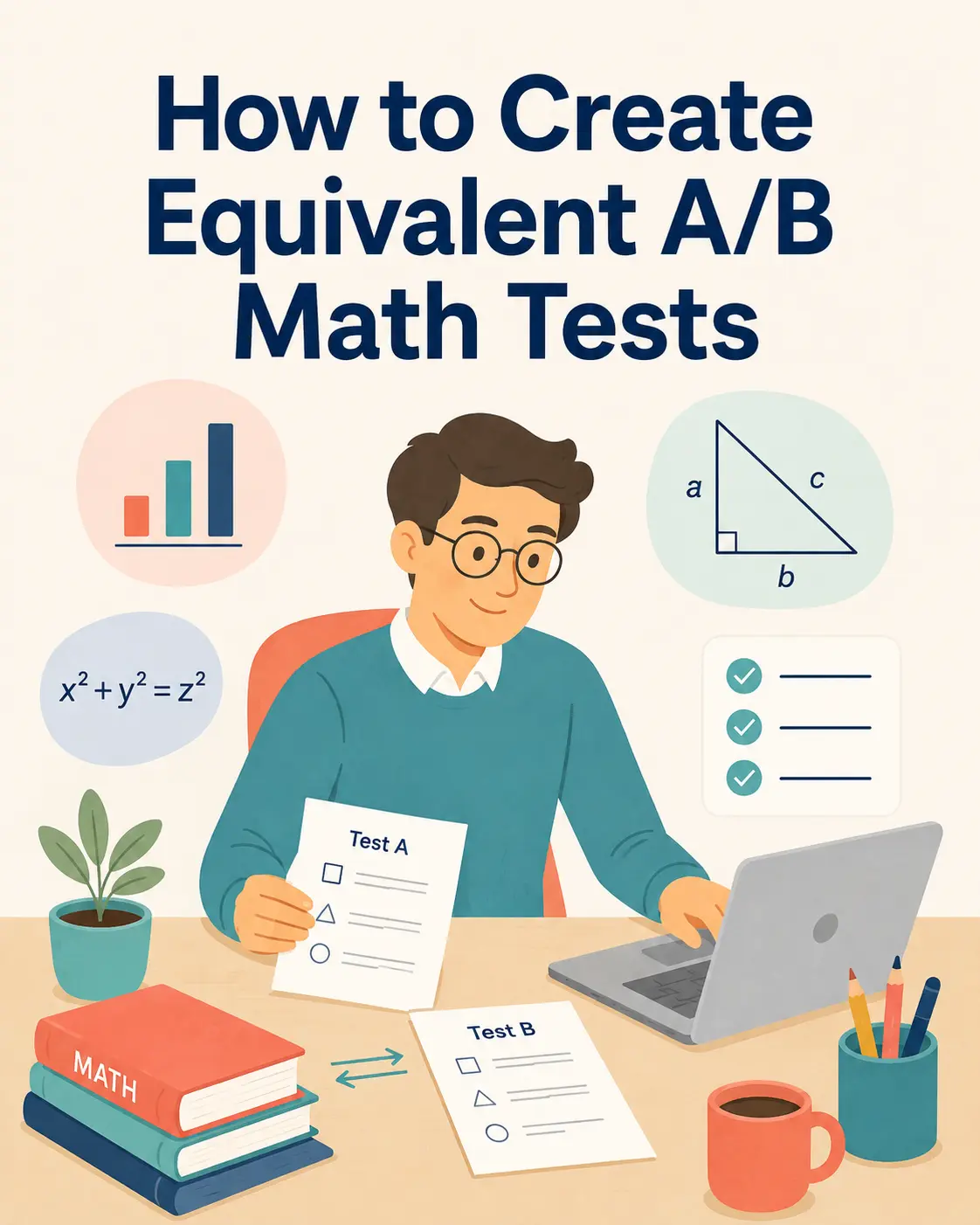
Teachers often need two versions of the same math assessment.
One class may sit close together.
A student may need a makeup test.
Another student may need a retake.
Two class periods might take the same assessment at different times.
The obvious solution is to create Form A and Form B.
The difficult part is making them genuinely equivalent.
Create printable math tests with equivalent versions and answer keys →
Equivalent Does Not Mean Identical
Changing the numbers in every problem can create a different-looking test, but that alone does not guarantee equal difficulty.
Consider:
Form A: 2x + 5 = 15
Form B: 7x - 13 = 58
Both are one-step linear equations after isolating the variable, but their arithmetic demands are not identical.
That difference may be acceptable.
But across an entire assessment, small differences can accumulate until one form is noticeably harder.
Keep the Skill Blueprint the Same
The strongest way to build A/B versions is to create the assessment structure first.
For example:
Question 1: integer operations
Question 2: simplify an expression
Question 3: one-step equation
Question 4: proportional relationship
Question 5: graph interpretation
Question 6: multi-step equation
Question 7: word problem
Question 8: application
Question 9: multi-concept problem
Question 10: reasoning problem
Then create a different question for each corresponding position.
Form A Question 6 and Form B Question 6 should measure essentially the same skill at a similar level of complexity.
Keep Difficulty Stable
If Form A requires students to solve a linear equation while Form B requires them to create an equation from a word problem, the forms are not really equivalent.
Check factors such as number of steps, arithmetic complexity, reading demand, diagrams, use of fractions and required reasoning.
Equivalent assessments do not need to be clones, but neither form should provide an obvious advantage.
Retakes Need Equivalence Too
A retake should provide a fresh opportunity to demonstrate the same learning.
Giving students the exact original test again can measure memory as well as mathematical understanding.
Giving them a completely different and harder test creates another fairness problem.
An equivalent second form provides a middle ground: new questions, same target skills.
Answer Keys Must Be Separate
Multiple versions also create a practical grading issue.
Make sure the answer key clearly identifies which form it belongs to.
Using a complete worked key for each version can reduce grading mistakes and make it easier to compare student methods.
AI Makes Versioning Much Faster
Traditionally, building a second form means rewriting questions manually, recalculating every answer and formatting another document.
That is exactly the kind of repetitive work where AI can help.
MathQuizily supports equivalent A/B versions alongside printable assessments and step-by-step answer keys.
The important principle remains the same:
same objectives + similar complexity + different questions.
That's what makes the second version useful rather than merely different.