Need a classroom-ready assessment? Use our AI math test generator for teachers to create a printable PDF with answer keys in minutes.
For the full guide, see math assessment with AI.
Regional Math Test Generators
There is no single perfect number of questions for every math test.
A ten-question Algebra assessment can provide more useful evidence than a 30-question test if those ten questions are chosen carefully.
The better question is:
How much evidence do I need to determine whether students understand the skills being assessed?
More Questions Do Not Automatically Mean a Better Test
Adding questions increases the amount of evidence collected, but it also increases testing time, grading time and student fatigue.
If ten questions all measure essentially the same procedure, the teacher may receive less useful information than from a shorter assessment covering several levels of understanding.
Quality and coverage matter more than raw length.
Match Test Length to Purpose
A quick classroom check might contain only three to five problems.
A short quiz could contain five to ten.
A chapter or unit test may require more, depending on the number of objectives being assessed and the complexity of each question.
Some mathematical tasks also naturally require more time.
A multi-step modeling problem is not equivalent to a one-step computation simply because both count as "one question."
The 10-Question Model
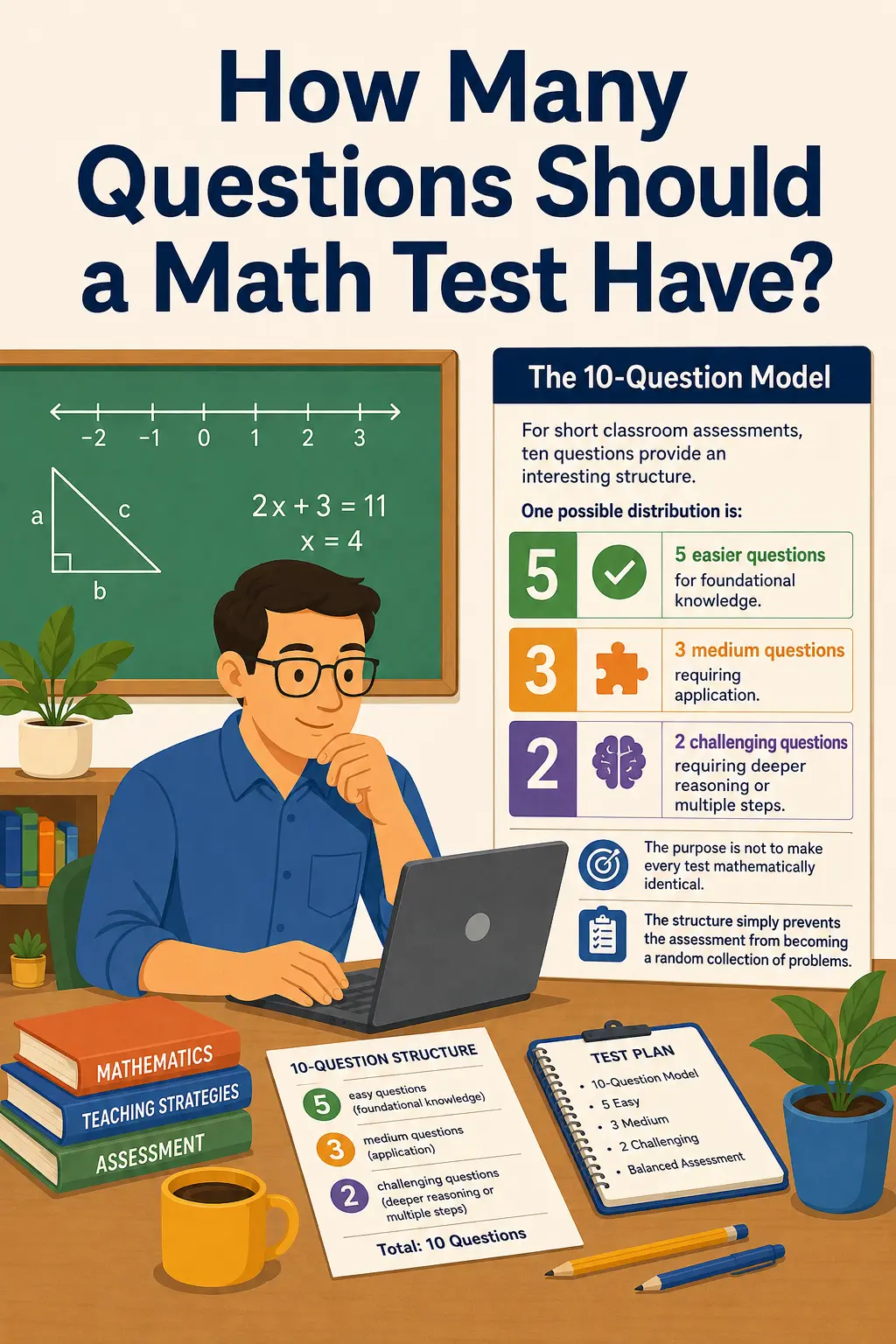
For short classroom assessments, ten questions provide an interesting structure.
One possible distribution is:
5 easier questions for foundational knowledge.
3 medium questions requiring application.
2 challenging questions requiring deeper reasoning or multiple steps.
The purpose is not to make every test mathematically identical.
The structure simply prevents the assessment from becoming a random collection of problems.
It creates a deliberate progression.
Why Difficulty Distribution Matters
Imagine Test A contains ten routine questions.
A student who has memorized the procedure may score extremely well without demonstrating whether they can apply the concept in a new situation.
Now imagine Test B contains ten unusually difficult questions.
Students who understand the core material may appear weaker than they really are.
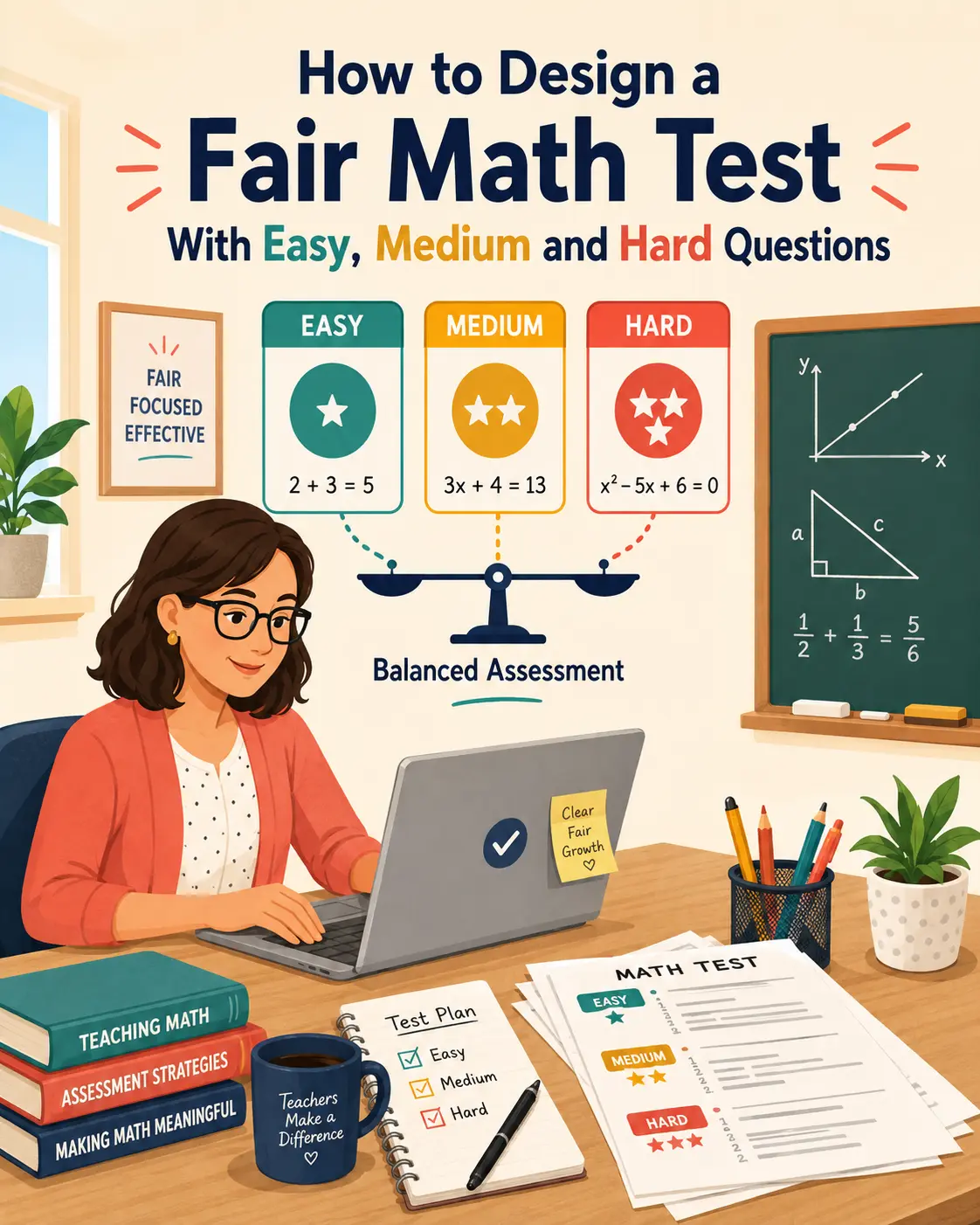
A balanced test gives students an opportunity to demonstrate fundamental knowledge while still distinguishing stronger levels of understanding.
Consider Time, Not Just Question Count
Before printing a test, solve it yourself or estimate how long each question should reasonably take.
A 10-question assessment containing diagrams, proofs and multi-step problems could easily take longer than a 20-question arithmetic quiz.
Student working time should therefore be part of assessment design.
Leave Space for Mathematical Thinking
Printable math tests should also allow students enough room to demonstrate their reasoning.
Compressing 20 problems onto one sheet may save paper but make the assessment harder to complete clearly.
Clean formatting, proper notation and adequate working space can make a short assessment feel more professional and easier to grade.
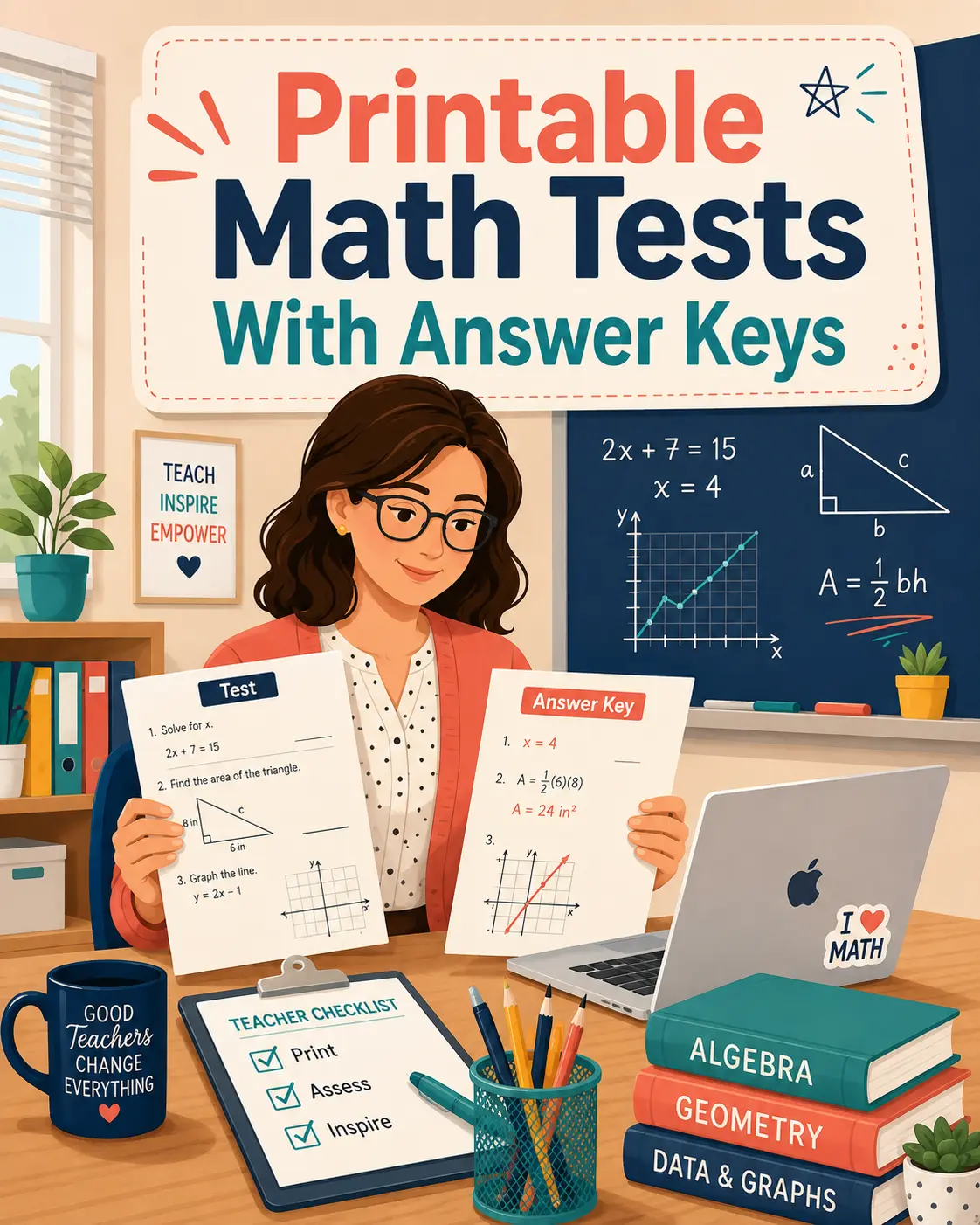
MathQuizily's printable test workflow uses a structured 10-question model with 5 easy, 3 medium and 2 hard questions, along with worked answer keys.
The Bottom Line
Do not begin by asking:
"How many questions can I fit on the test?"
Begin with:
"What evidence do I need from my students?"
Then choose enough questions to collect that evidence without making the assessment unnecessarily long.
For many classroom assessments, ten carefully chosen questions can be far more informative than thirty repetitive ones.