Explore exam-ready workflows with our AI math test generator, and learn what makes AI-generated math exams more consistent and fair. For the full guide, see AI math exams and assessment.
Can AI really be trusted for math exams? Learn what teachers control, what AI never decides, and why AI-based assessment is safer in 2026.
Why Trust Is the Biggest Barrier to AI Exams
AI is everywhere in education in 2026.
Lesson planning. Practice. Homework. Feedback.
But assessment is different.
When grades matter, teachers, parents, and schools ask a critical question:
> Can AI really be trusted to help create math exams?
The short answer is: yes — when AI is used correctly.
The longer answer requires understanding what AI does, and what it never does.
---
What AI Actually Does in Math Exam Creation
AI does not "decide" what students should be tested on.
In assessment-focused tools, AI's role is limited to:
AI accelerates processes that teachers already do — it doesn't replace pedagogical judgment.
Learn more: How to Create a Complete Math Exam in 10 Minutes Using AI
---
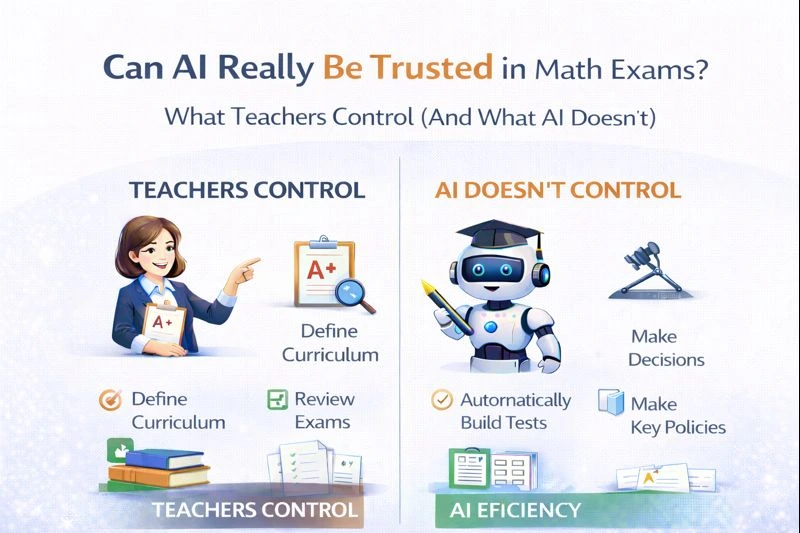
What Teachers Always Control
This is the most important part — and often misunderstood.
Teachers remain fully in control of:
1. Curriculum and Topics
Teachers decide:
AI never chooses content independently.
2. Difficulty Structure
Teachers define:
AI follows structure — it does not invent it.
3. Final Exam Content
Every AI-generated exam can be:
Nothing is automatically "locked in".
4. Grading and Interpretation
AI may provide:
But:
---
What AI Never Does
To build trust, it's important to be clear about boundaries.
AI never:
Assessment responsibility remains human — as it should.
---
Why AI Is Often Safer Than Manual Exams
This may sound surprising, but many schools find AI-based exams more reliable than manual ones.
Manual exam risks:
AI-assisted exam benefits:
AI reduces human error, not human authority.
Learn more: The Real Reason Math Assessment Feels Unfair (And How AI Fixes It)
---
Addressing Common AI Fears in Schools
"AI will replace teachers"
No. AI removes repetitive tasks so teachers can focus on teaching.
"AI makes exams less serious"
On the contrary — structure and consistency increase seriousness.
"AI is unpredictable"
Unstructured tools are unpredictable. Assessment-focused AI follows strict parameters.
"Parents won't trust AI exams"
Parents usually trust exams more when:
---
Why Trust Comes From Transparency
The most trusted assessment systems share one thing: clarity.
AI-based exam tools increase transparency by:
This reduces disputes — not increases them.
Learn more: Why Free Math Tools Fail at Assessment (And What Teachers Use Instead)
---
How Schools Use AI Responsibly in 2026
Responsible schools:
AI is treated as a tool, not an authority.
Learn more: Practice Platforms vs Exam Tools: Why Math Assessment Needs Its Own Category
---
FAQ – Trusting AI in Math Exams
Is AI allowed in assessment?
Yes — when teachers control content and grading.
Can AI exams be audited?
Yes. Structure and content are fully visible.
Is AI biased?
Less than humans — because structure is consistent.
Do teachers lose control?
No. Teachers gain time, not lose authority.
---
Short Summary
AI can be trusted in math exams when it supports structure — not judgment.
In 2026, teachers remain in full control of content, grading, and decisions, while AI handles speed, consistency, and formatting.
---
Create Transparent, Teacher-Controlled Math Exams
If assessment still feels risky, it's not because of AI — it's because of unstructured tools.