Explore exam-ready workflows with our AI math test generator, and learn what makes AI-generated math exams more consistent and fair. For the full guide, see AI math exams and assessment.
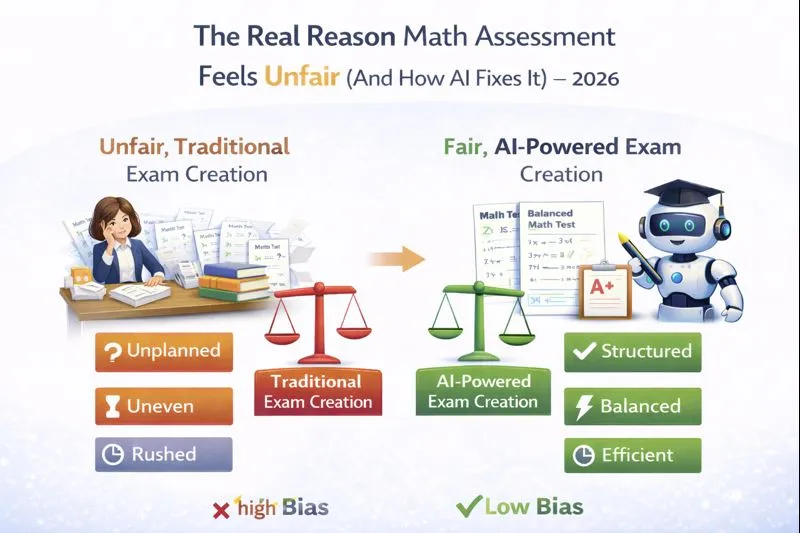
Math assessment feels unfair when difficulty varies, grading is unclear, and expectations are inconsistent. AI-generated math exams improve fairness by standardizing structure, balancing difficulty, and making grading criteria transparent.
Why So Many Students Feel Math Grades Are Unfair
Few school subjects create as many disputes as mathematics.
Students say:
Parents say:
Teachers feel:
The issue is rarely the math itself.
The issue is how assessment is designed.
---
Fairness Is Not About Easier Tests
A common misconception is that fairness means making exams easier.
It does not.
Fair assessment means:
Students accept challenging exams when they feel:
> "This test was fair—even if it was hard."
---
The Hidden Causes of Unfair Math Assessment
1. Inconsistent Difficulty Between Tests
When exams are created manually:
Two students at the same grade level may effectively take different exams.
This undermines trust.
2. Unclear Expectations for Students
Many exams fail to show:
Students then guess what the teacher "wants" instead of focusing on math.
3. Grading Rules Created After the Test
In many classrooms:
This leads to:
4. Over-Reliance on Practice Materials
Practice tools often:
When assessments look different from practice, students feel misled.
---
Why Teachers Are Caught in the Middle
Teachers want to be fair.
But they face:
Fair assessment requires design time—something teachers rarely have.
---
How AI Improves Fairness in Math Assessment
AI math test generators address fairness at the design level, not the grading stage.
1. Balanced Difficulty by Design
AI generates exams with:
This reduces random difficulty swings.
2. Transparent Assessment Structure
AI-generated exams typically include:
Students know what kind of thinking is required.
3. Built-In Grading Logic
Instead of creating grading rules afterward, teachers receive:
This makes grading:
4. Comparable Exams Across Classes
When multiple classes use the same structure:
AI supports consistency without removing teacher choice.
---
Example: Manual vs AI-Generated Exam
Manual exam:
AI-generated exam:
Same topic.
Very different student experience.
---
Does AI Make Assessment "Too Mechanical"?
No.
AI handles:
Teachers handle:
Fairness comes from clarity, not automation.
---
Why Fairness Matters More Than Ever in 2026
In modern education:
When assessment feels unfair:
Fair assessment is not optional—it is foundational.
---
FAQ – Fair Math Assessment & AI
Does AI remove bias completely?
No—but it reduces random variation and inconsistency.
Can AI-generated exams still be challenging?
Yes. Fair does not mean easy.
Who is responsible for the final grade?
Always the teacher.
Do students accept AI-generated exams better?
Yes—because expectations are clearer.
---
Key Takeaway
Math assessment feels unfair not because students are weak, but because exams lack structure, clarity, and consistency. AI improves fairness by fixing assessment design—not by lowering standards.
---
Final Thought
Fair assessment is not about perfection.
It is about predictability, transparency, and trust.
AI math test generators help teachers achieve fairness where time constraints make it otherwise difficult.
In 2026, fairness in math assessment is no longer a mystery—it is a design choice.
---
Create Fair, Structured Math Exams
Generate complete, printable math exams designed for fairness, structure, and real classroom use.
Try MathQuizily and make fairness a design choice.
---