Explore exam-ready workflows with our AI math test generator, and learn what makes AI-generated math exams more consistent and fair. For the full guide, see AI math exams and assessment.
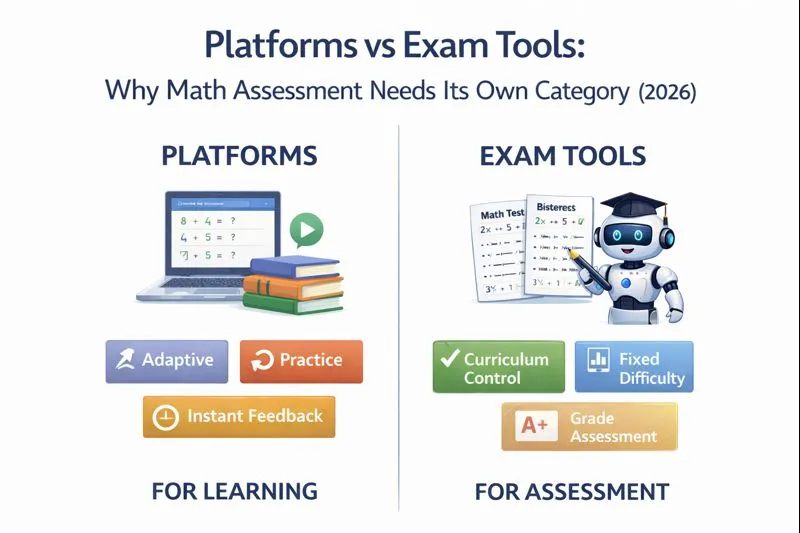
Practice platforms are designed for learning and repetition, while exam tools are designed for measurement and fairness. In 2026, math assessment requires its own category of tools—focused on structure, consistency, grading, and printable exams.
Why One Tool Can't Do Everything
Modern math education uses more digital tools than ever before.
Students practice with:
Teachers assess with:
The problem begins when practice tools are expected to do assessment work.
Learning and measuring learning are not the same task.
---
What Practice Platforms Are Built For
Practice platforms are optimized for:
They encourage:
This makes them excellent for skill building.
But these strengths become weaknesses during assessment.
---
What Exam Tools Must Do Differently
Assessment tools have different requirements.
They must provide:
Assessment is not about exploration.
It is about measurement.
---
The Risk of Using Practice Platforms for Exams
When practice platforms are used for assessment, common problems appear:
1. Random Difficulty
Adaptive systems adjust difficulty in real time.
Great for learning.
Terrible for comparability.
Two students may complete entirely different tasks and still receive a grade.
2. Lack of Exam Structure
Practice platforms focus on individual items, not exams.
Missing elements:
This weakens assessment validity.
3. Unclear Grading Criteria
Many practice tools:
This makes grades harder to explain and defend.
4. Screen-Dependent Assessment
Practice platforms assume:
Formal assessment often requires:
---
Why Math Assessment Is Especially Sensitive
Math assessment must measure:
This requires:
Random or adaptive tasks distort results.
---
Why Assessment Needs Its Own Tool Category
In 2026, schools increasingly separate:
Assessment tools are designed specifically to:
This separation improves both learning and grading.
---
How AI Exam Tools Fill the Gap
AI-based exam tools are not practice platforms.
They focus on:
Instead of adapting to the student, they adapt to the assessment goal.
Tools like MathQuizily are built specifically for this purpose.
---
Example: Same Topic, Two Tool Types
Practice platform:
Exam tool:
Both are valuable.
They serve different purposes.
---
Why Printable Exams Remain Central
Despite digital growth:
Printable exams provide:
Exam tools that cannot print are incomplete.
---
Common Objection: "But Students Learn Digitally"
Yes—and they should.
But assessment answers a different question:
> "What can the student demonstrate independently, under equal conditions?"
That question still requires exams.
---
FAQ – Practice vs Assessment Tools
Can practice platforms be used for grading?
Not reliably. They are not designed for comparability.
Do exam tools limit personalization?
No. They limit randomness, not differentiation.
Are exam tools outdated?
No. They are essential for valid assessment.
Why do separate categories matter?
Because mixing purposes weakens both learning and grading.
---
Key Takeaway
Practice platforms help students learn. Exam tools measure learning. Treating them as the same category leads to unfair assessment and unclear results.
---
Final Thought
Education benefits from many tools—but not from confusing their roles.
In 2026, effective math education recognizes a simple truth:
That's why math assessment now belongs to its own category.
---
Create Assessment-Ready Math Exams
Generate complete, printable math exams designed for fairness, structure, and real classroom use.
Try MathQuizily and give assessment its own category.
---