Explore exam-ready workflows with our AI math test generator, and learn what makes AI-generated math exams more consistent and fair. For the full guide, see AI math exams and assessment.
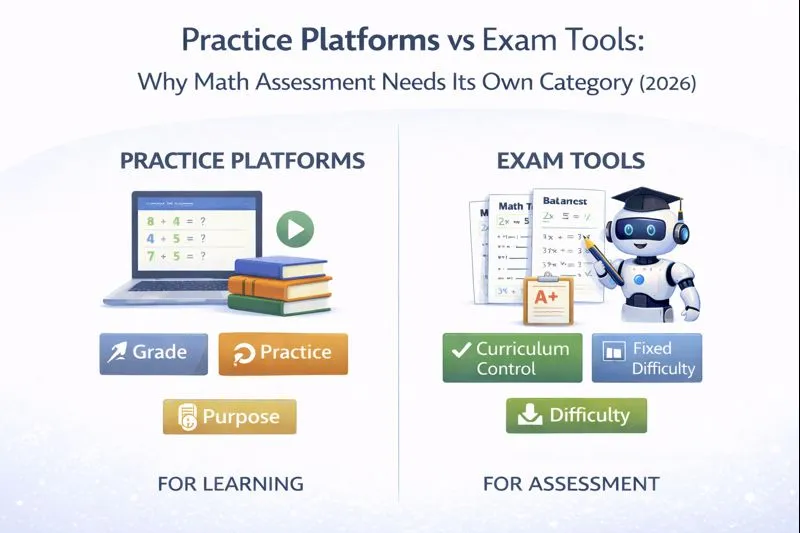
Math practice platforms help students learn — but assessment requires different tools. Learn why exam creation needs its own category in 2026.
Why Math Tools Are Often Used for the Wrong Purpose
Digital math platforms have become standard in classrooms worldwide.
Students practice daily. Teachers assign exercises. Parents see progress.
But a critical mistake happens over and over again:
> The same tools are used for both learning and assessment.
In 2026, schools are beginning to realize that practice and assessment are fundamentally different tasks — and need different tools.
---
Practice and Assessment Serve Different Goals
Practice is designed to:
Mistakes are expected.
Feedback is immediate.
Scores are not final.
Assessment is designed to:
Mistakes have consequences.
Conditions must be controlled.
Results must be comparable.
Using the same tool for both creates confusion — and unfair outcomes.
---
Why Practice Platforms Struggle With Assessment
Practice platforms excel at engagement.
They struggle with assessment for structural reasons.
1. Adaptive Difficulty Breaks Comparability
Adaptive systems change questions based on performance.
That's perfect for learning.
It's disastrous for exams.
Two students should not receive fundamentally different tests when being graded.
2. Randomization Undermines Fairness
Many platforms rely on:
This makes results hard to interpret and nearly impossible to defend in grading discussions.
Learn more: The Real Reason Math Assessment Feels Unfair (And How AI Fixes It)
3. Limited Curriculum Control
Practice tools often:
Assessment requires strict alignment to what was taught — not what is available.
4. No Exam-Ready Output
Assessment still requires:
Online-only practice tools fail here.
Learn more: Why Printable Assessments Still Matter in an AI-First Classroom
---
Why Assessment Tools Need Their Own Category
Assessment is not a feature.
It is a discipline.
Dedicated exam tools focus on:
They are built for measurement, not engagement.
---
The Rise of AI-Powered Exam Creation
AI has not replaced teachers — it has replaced manual formatting and repetition.
Modern AI exam tools allow teachers to:
This creates a new category: AI-powered assessment tools
Learn more: How to Create a Complete Math Exam in 10 Minutes Using AI
---
Why Schools Are Separating Learning From Measuring
Forward-thinking schools now use:
This separation:
Most importantly, it restores trust in assessment results.
---
Practice Platforms Aren't the Problem
Practice platforms are valuable.
They just aren't designed to:
Trying to force them into assessment creates frustration for teachers and students alike.
---
Assessment Quality Directly Impacts Learning
Poor assessment leads to:
High-quality assessment:
This is why assessment deserves its own tools.
---
FAQ – Practice vs Assessment
Can practice platforms be used for tests?
Not reliably. They lack structure, comparability, and grading support.
Why not just export worksheets?
Worksheets rarely reflect exam conditions or grading logic.
Is AI assessment safe?
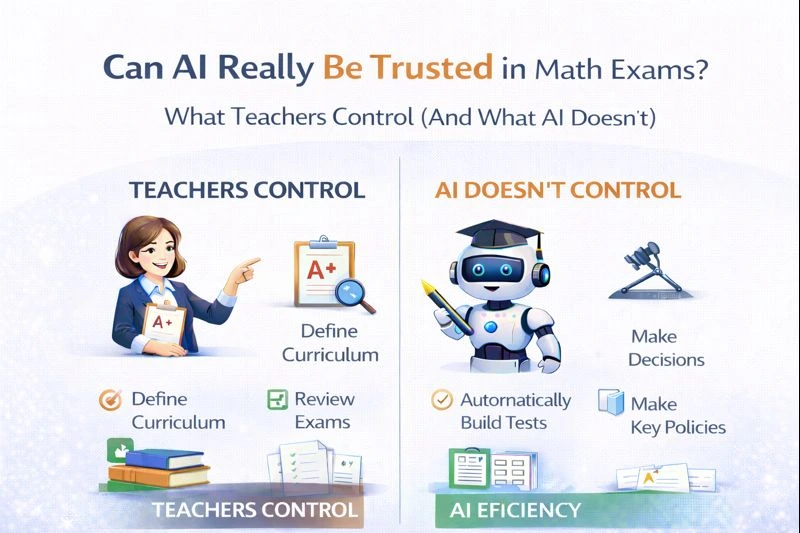
Yes — when teachers control content and structure.
Do schools need subscriptions?
Not necessarily. Many prefer pay-per-test assessment tools.
---
Short Summary
Practice platforms help students learn.
Assessment tools measure learning.
In 2026, schools are separating these roles — using practice platforms for engagement and AI-powered exam tools for fair, structured assessment.
---
Create Structured, Exam-Ready Math Tests
If assessment still feels improvised, the problem isn't your standards — it's your tools.
Create structured, exam-ready math tests built for real assessment