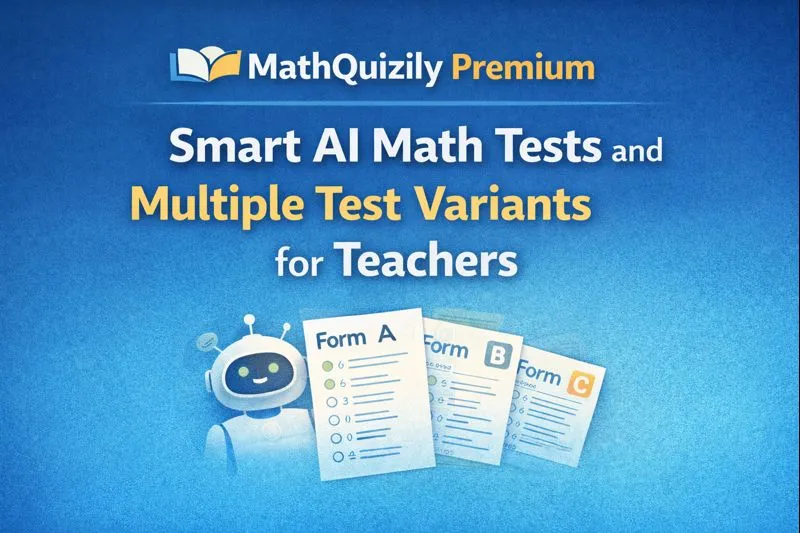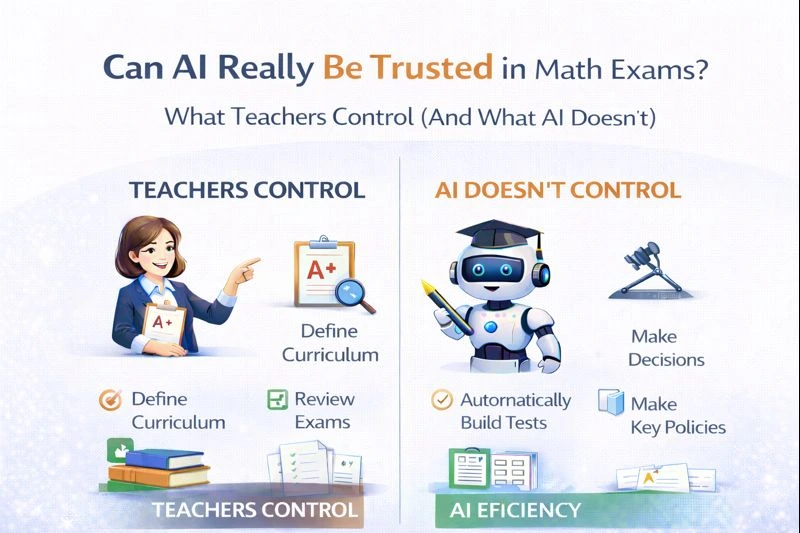
Explore exam-ready workflows with our AI math test generator, and learn what makes AI-generated math exams more consistent and fair. For the full guide, see AI math exams and assessment.
Free math tools are great for practice — but they fall short when assessment matters. Learn why educators in 2026 are upgrading to structured, AI-generated exams for reliable evaluation.
Introduction: Free Tools Feel Powerful — Until You Need Results
Free math tools are everywhere.
With just a few clicks, teachers, parents, and students can generate worksheets, practice questions, or instant exercises. At first glance, it feels revolutionary.
But something changes the moment assessment matters.
When it's time to:
Many educators discover that free tools no longer deliver what's needed.
In 2026, this realization is driving a clear shift toward purpose-built assessment solutions.
---
Why Free Math Tools Are So Appealing
Free tools succeed for a reason. They are:
They lower the barrier to entry and make math content feel instantly available.
For practice and exploration, this can be useful.
But assessment is a different category entirely.
---
The Core Limitation: Randomness Without Structure
The biggest weakness of free math tools is not quality — it's lack of structure.
Most free generators:
As a result:
This randomness undermines assessment.
---
Assessment Requires More Than Questions
A math assessment is not a collection of tasks.
It is a designed measurement.
Effective assessment requires:
Free tools are optimized for speed, not measurement.
When teachers rely on them for assessment, they often end up compensating manually — losing the time they hoped to save.
---
Why Free Tools Fail in Real Classrooms
In real classrooms, assessment must work under constraints:
Free tools rarely support:
What looks efficient at first becomes fragile at scale.
---
The Hidden Cost of "Free"
Free tools may not charge money — but they charge time and confidence.
Teachers report that using free tools for assessment leads to:
Assessment should increase clarity, not doubt.
---
Why Teachers Eventually Upgrade
Teachers don't move away from free tools because they dislike them.
They move away because their needs change.
As soon as teachers need to:
They require tools designed for that purpose.
AI-powered exam generators like MathQuizily meet this need by focusing on assessment first, not content generation alone.
---
What Purpose-Built Assessment Tools Do Differently
Unlike free generators, assessment-focused tools:
AI is used not to impress — but to standardize and support pedagogy.
---
Why Printable Exams Still Matter
Even in digital classrooms, printable exams remain central because they:
Free tools often overlook this practical reality.
Purpose-built tools embrace it.
---
Assessment Is About Trust
At its core, assessment answers one question:
> Can we trust the result?
Randomly generated content cannot build that trust.
Structured assessment can.
---
Short Summary
| Scenario | Best Tool |
|---|---|
| Quick practice | Free math tools |
| Formal assessment | Purpose-built AI exam generators |
In 2026, assessment is no longer an afterthought — it is a dedicated process.
---
Frequently Asked Questions
Are free math tools useless?
No. They are useful for exploration and practice, but not reliable for formal assessment.
Can AI improve assessment quality?
Yes, when AI is used to generate structured exams based on clear criteria.
Why not just reuse old exams?
Reused exams limit differentiation and don't adapt to changing student needs.
---
Final Thoughts: Free Is Not the Same as Fit-for-Purpose
Free tools have played an important role in expanding access to math content.
But assessment is not about access — it's about accuracy.
As classrooms grow more complex, teachers need tools that respect the responsibility of evaluation.
That is why more educators are choosing AI-generated exams designed specifically for assessment — not just content generation.
---
Create Assessment-Ready Math Exams
Generate complete, printable math exams designed for fairness, structure, and real classroom use.
Try MathQuizily and move beyond free tools when assessment matters.