Explore exam-ready workflows with our AI math test generator, and learn what makes AI-generated math exams more consistent and fair. For the full guide, see AI math exams and assessment.
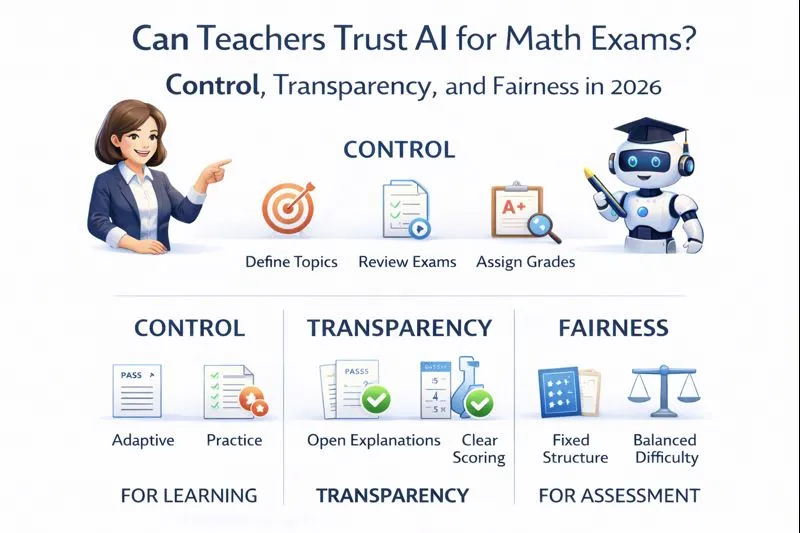
AI can be trusted for math exams when teachers control structure, content, and grading logic. In 2026, transparent, curriculum-aligned AI exam tools improve fairness without removing teacher authority.
The Core Question Teachers Are Asking
AI is everywhere in education.
But when it comes to exams, teachers ask a different question:
> "Can I trust AI with something as important as assessment?"
This concern is valid.
Grades affect:
Trust is not optional.
---
Why "AI" Alone Is Not the Issue
The problem is not AI itself.
The problem is how AI is used.
There is a crucial difference between:
Trust depends on who remains in charge.
---
What Makes AI Exams Untrustworthy
Teachers lose trust when AI systems:
These systems feel like black boxes.
Black boxes do not belong in assessment.
---
What Trustworthy AI Exam Tools Do Differently
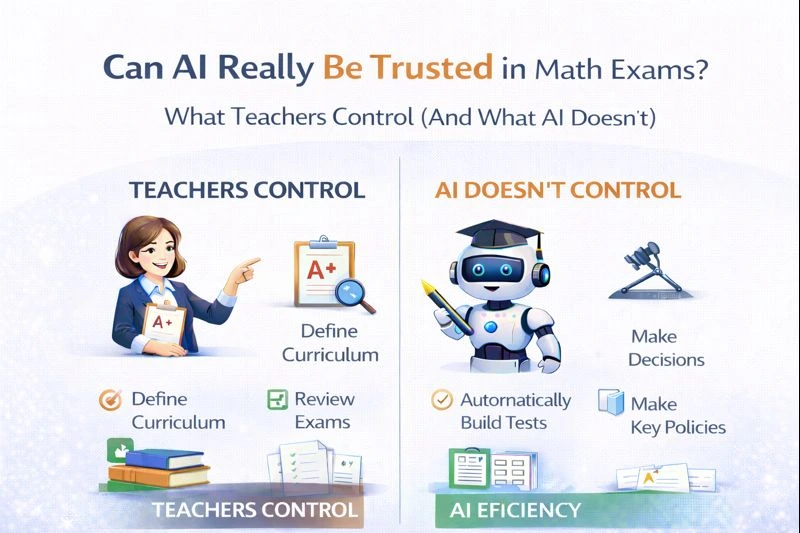
Trustworthy AI exam tools are built around teacher authority, not automation for its own sake.
They provide:
1. Full Teacher Control
Teachers decide:
AI assists — it does not decide.
2. Transparent Structure
Every exam has:
Teachers know why a question exists.
3. Explainable Output
A trustworthy AI exam tool can answer:
If the tool cannot explain itself, it should not assess students.
---
Why Transparency Matters More Than Speed
AI promises speed.
But assessment requires:
If a parent asks:
> "Why did my child receive this grade?"
The teacher must have an answer.
Transparent exam tools support that conversation.
---
Fairness Is a Design Choice
Fairness does not happen automatically.
It is designed.
Trustworthy AI exam tools:
This protects both students and teachers.
---
The Role of Printable Exams in Trust
Printable exams may seem old-fashioned — but they are essential for trust.
They provide:
In many schools, printable exams are still the legal standard for assessment.
AI that cannot generate printable exams is incomplete.
---
AI Does Not Replace Professional Judgment
A common fear is:
> "AI will replace teacher judgment."
In reality, good AI does the opposite.
It:
Teachers still:
AI supports — it does not override.
---
Legal and Ethical Considerations (2026)
Across many regions, assessment must be:
Opaque AI systems risk:
Teacher-controlled AI exam tools reduce these risks.
---
When AI Builds Trust Instead of Fear
Teachers begin to trust AI when they experience:
Trust grows through predictability, not novelty.
---
FAQ – Trusting AI for Math Exams
Can AI grade exams fairly?
Only when grading criteria are explicit and teacher-reviewed.
Is AI assessment legal?
Yes — when aligned with curriculum and transparent.
Does AI reduce teacher autonomy?
No. Poorly designed tools do. Good tools increase autonomy.
Should exams still be printable?
Yes. Printability remains a cornerstone of fair assessment.
---
Key Takeaway
Teachers can trust AI for math exams when AI is transparent, controllable, and curriculum-aligned — and when teachers remain in charge of assessment decisions.
---
Final Reflection
AI in assessment is not about surrendering control.
It is about reclaiming time without sacrificing:
In 2026, the most trusted AI exam tools are not the most autonomous —
they are the most teacher-respecting.
---
Create Trustworthy AI-Generated Math Exams
Generate complete, printable math exams with full teacher control over structure, difficulty, and grading.
Try MathQuizily and experience AI you can trust.
---